Start here, or read the most recent posts below.

Beginnings

Showing posts with label genealogy. Show all posts

Sunday, August 27, 2017

A brief summary of the ancestry of Vernon Eugene Coltrane.

Our Coltrane ancestors have been in central North Carolina for nearly three hundred years, since long before the French and Indian Wars. The first Coltrane known to have been born in North America was William Coltrane, born sometime around 1743 in eastern North Carolina.

William Coltrane was the only son of David Coltrane and Mary Trotter and was among the earliest Europeans to settle in what is now Randolph County.
Deep River settlers, 1750s-1780s

David Coltrane was the third son of Patrick Coltrane and Elizabeth Stewart of Wigton, Scotland; born sometime in the first decade or so of the eighteenth century.  He emigrated from Scotland to North America sometime before 1738.  Colonial records indicate that David owned at least 530 acres in what was then Edgecombe County, and was appointed Justice of the Peace in 1743.

At one time it was believed that David had returned to Scotland to settle his father's estate and was lost at sea, but more recent research indicates that our David Coltrane was most likely a member of the first British military force raised entirely on American soil. Being neither regular British army nor navy, some have called these men the first American marines.

David Coltrane is believed to have been among the men mustered into Gooch's Regiment, which unsuccessfully attempted to seize Cartagena, one of Spain's principal gold-trading ports in the colony of New Granada.

Lindsay Coltrane
Mosquito-borne diseases such as Yellow Fever and Malaria were as lethal to Europeans as Old World diseases were to the aboriginal peoples of the Americas, and many men died during the long voyage from the Carolinas to Cuba and then to Cartagena.  It is believed that such was the fate of our grandfather, David Coltrane and that he was buried at sea sometime before June of 1745.

Mary Trotter married several more times in the course of her life, becoming the wife of Laws Preddy on June 27, 1745.  Additional records indicate that she later married John Messhenger, in 1752, and finally Robert Wallace, in August of 1754. Records also indicate that Mary's father, James Trotter, was appointed guardian of William Coltrane.  Mary's last will and testament, probated October 27, 1792, mentions only one son.

It is not certain when William Coltrane settled in what is today Randolph County, North Carolina. An indenture dated August 20, 1760, tells us that William purchased a 302-acre tract referred to as the Messuage Tenement from Christopher Smith of Orange County.  The property lay along Polecat Creek, in the Deep River watershed.

About that same year, William married Rachel Worthington, daughter of Jacob and Abigail Worthington. The consensus among most researchers today is that William and Rachel raised eight children (David, Abigail, Jacob, Mary, James, William, Daniel, and Rachel).

Emma and Solomon H. Coltrane.
wedding portrait?
The site of William and Rachel Coltrane's original homestead now lies beneath the waters of a man-made lake, having been submerged by the completion of the Randleman Dam project in the early 2000s. The land remained in possession of one of William's descendants until the lake was created.

William Coltrane's sixth child, also named William, was born in 1774. Sometime around 1798, Billy, as he was known, courted and married Sarah Frazier, a daughter of James Frazier and Martha Millikan. By then the Coltranes had become members of the Religious Society of Friends and were firmly rooted in the Quaker community that took root across the region. Randolph County is home to several of the oldest Quaker Meetings in the nation.

William and Sarah had nine children. Their third child, a boy they named Lindsay Coltrane, was born in 1816 and grew up to become a farmer like his father, and his grandfather before. In 1841 Lindsay Coltrane married Margaret Hodgin, a daughter of Solomon Hodgin and Tamar Dicks. In time Lindsay and Margaret brought eleven children into the world.

Lee and Pearl Coltrane
Solomon Hodgin Coltrane, the fourth child of Lindsay and Margaret Coltrane, was born in 1847. Solomon married Emma Osborn, a daughter of Thomas Osborn and Mary Kersey. Among their eight children was a boy they named Lee Beacher(or Beecher) Coltrane.

Lee was a summer baby, born June 28, 1891, and like most of his ancestors, Lee scratched his living from the red clay under his feet. Upon retirement from the dairy farming business, Lee sold most of his farm to developers who built the Shannon Hills neighborhood, near Vandalia Road and Rehobeth Church Road.

Lee outlived two of his three wives, but his eight children all came from his first wife, Pearl Wakefield. My grandfather, Vernon Eugene Coltrane, was their fourth child, born just over a century ago on November 7, 1916.

Vernon grew up on his father's farm. He graduated from Sumner School in 1933 and obtained a degree in economics from Guilford College in 1937. While at Guilford, Vernon met our grandmother, Trudy Cochran, daughter of Luella Farmer and the late Dr. Ira Cochran of Kernersville; they were married in 1938.

Vernon E Coltrane (1916-2004)
Shortly after the birth of their first child, Brenda, Vernon was drafted to serve in World War II.  After basic and officer training, 2nd Lt. Vernon Coltrane was stationed at Ledo, Assam, India. His company worked on what came to be known as the Stillwell Highway, which ran from the station at Ledo to Kunming, Yunnan, China.

The road was built so that Western Allies could supply the Chinese after the Burma Road was cut off by the Japanese in 1942. Originally called Ledo Road, the highway was renamed Stilwell Road, after General Joseph Stilwell, in early 1945. The road fell into disrepair after the war, but efforts have been made to rehabilitate the highway.

After the war, Vernon found employment with the United States Postal Service and retired after more than thirty-one years in 1973.  He and Trudy raised a total of four children, (all still living as of this writing) and lived out their days traveling the world as long as their health allowed. Trudy died in early 2000; Vernon followed in 2004.

Friday, August 25, 2017

George Wakefield, 1862-1956

My maternal grandfather was Vernon Eugene Coltrane; his maternal grandfather was George Wakefield, the fifth child of Ann Haines and Henry Wakefield. George was the middle child of nine, born September 11, 1862, near present-day Varney, Ontario, Canada.

George Wakefield, seated
When George was still a boy the family immigrated to the United States, settling in the Friendship community a few miles west of Greensboro.

The Wakefields prospered in the warmer southern climate, and their integrity earned them the respect and friendship of their new neighbors. It is known that Henry Wakefield, Sr., and at least one of his sons, William, became naturalized citizens in 1880. Whether Ann or the other children ever became citizens I have not yet been able to determine.

As a young man, George attended the New Garden Boarding School, a few miles east of the family farm. The Religious Society of Friends, better known as Quakers, founded New Garden in 1837. It became the four-year liberal arts institution known today as Guilford College in 1888.

George has been painted, perhaps unfairly, for much of the last seventy years or more, as a wanderer, based on a passage in The Family of Henry Wakefield, North Carolina, 1805-1950.
"As a young man he had the wanderlust and his first work away from home was with Mr. Seymour Steel's Livery stable in Greensboro... where he earned $10 per week and his board."
Moving ten miles down the road, even in the days before automobiles, hardly seems like wanderlust. Ten dollars in 1880 was equivalent to about $223 in today's money. Add meals and a bed and George had a pretty sweet deal going on down at the stable.

Compared to his brothers, who managed a successful business while attending medical school or seminary at the same time, George may not have seemed headed for a life of distinction, but George Wakefield did something not many humans do: he lived to be almost a century old. In fact, George Wakefield outlived all but one of his siblings.

Let's start over. 

George Wakefield was born in Canada during the American Civil War, and moved to North Carolina with his family, during Reconstruction. George got an education and set about finding something useful to do.

As a farmer's son, George was no stranger to physical work, and like many of the Wakefields, he was very tall, so he was probably a powerful man in his prime. George was was neither lazy nor dull, he excelled at mathematics while at the New Garden school, but he was more physically suited to working with his hands and body than sitting behind a desk, so George went to work.

George Wakefield, in 1948, with his daughter Pearl,
grandson, Vernon Coltrane, and great-granddaughter, Brenda 
After earning a little nest egg at the livery in Greensboro, George is known to have traveled to Missouri to visit one of his uncles (perhaps the wanderlust remark noted above would be more applicable here), where he lived and worked in a sawmill camp. 

Upon returning to Greensboro, George joined Company Number One of the Greensboro Volunteer Fire Department and worked for a time with his brothers at their hardware store.  Later he worked for the Richmond and Danville Railroad as well as for J.I. Case, but George Wakefield is perhaps best remembered as a dairy farmer.

In 1888, at 26 years old, George married Alice Hayes Reid, three years his junior. The marriage produced eight children over the next fifteen years: Pearl, Lillian, Hallie and Beulah, Edna, Esther, George, and Thomas. Hallie and Beulah were twins, but Beulah died at a very young age. George and Alice had been married for fifty-one years when Alice died in 1939. George was 76. Their daughter Edna died the following year.

George lived another seventeen years, part of the time with his daughter, Pearl, and her husband, Lee B. Coltrane. George and Alice Wakefield's surviving children produced thirty-one grandchildren, the largest branch of the Henry Wakefield family tree. When he died, George Wakefield was over 93 years old.

Thursday, August 24, 2017

The children of Henry and Ann Wakefield in North Carolina

Ann Haines and Henry Wakefield had eight children - five sons and three daughters - over the eighteen years between 1855 and 1873. When the Wakefields decided to relocate to North Carolina in 1871, after roughly a generation in Canada, the Civil War was still a very recent memory. Federal troops still occupied much of the former secessionist Confederacy and Reconstruction was in full swing. Outsiders, especially northerners, would have generally been looked upon with deep suspicion across much of the South.

North Carolina was no exception, and perhaps we should pause to wonder what, besides a  warmer climate, would have attracted a man like Henry Wakefield to this particular place; a section of a state that retained strong Unionist leanings throughout the Civil War.

Children of Ann Hunt Haines and Henry Wakefield, Sr.
The region around Guilford County was known as the 'Quaker Belt'. Members of the Religious Society of Friends, including some of our Coltrane ancestors, made up significant numbers of the early European settlers in the area.

Most Quakers back then were abolitionists and pacifists opposed to slavery and violence of any kind. Before the war, majorities in most of the counties of the Quaker Belt voted against secession by wide margins, and many men refused conscription and faced death rather than fight. Union sympathies ran deep across the region. Friendship, North Carolina probably looked like about the most civilized place south of the Mason-Dixon line to Henry Wakefield in 1870 and influenced his decision to bring his family to this place after military hostilities, and slavery had ceased.

All the Wakefield children, except for Ellen, were born in Canada and varied in age from toddlers to late teens when they arrived in North Carolina during the winter of 1871. Soon after arrival the younger children began attending a local school organized by the community, and most furthered themselves at New Garden Boarding School, better known since 1888 as Guilford College.

William Haines Wakefield was born in 1855. He studied at New Garden Boarding School, taught school for a couple of years, and then, with his father's backing and his brothers' help, established the W. H. Wakefield Hardware Company in Greensboro in 1879.


Between 1886 and 1890, while managing the business, William also studied medicine, first at Jefferson Medical College in Philadelphia, and later at Louisville Medical College, where he graduated with honors.

Doctor Wakefield, practiced in several cities before he settled in Charlotte in 1895, where he helped establish what is today Novant Health Presbyterian Medical Center. He was also the editor of the North Carolina Medical Journal for a time. He retired from practice about six years before his death in 1929.

Will's sister, Esther Wakefield, was born in 1857, and attended New Garden school before marrying G.W. Armfield, in 1875; the couple had eight children. She died in 1942, 85 years old.

Henry Wakefield, Jr. like most of his brothers, was a tall man, standing about 6'2". He was born in 1859 and migrated south with the family at about twelve years old. As a young man, he worked as a clerk in his brother's hardware store, until it was sold in 1893. He then moved to Danville, Virginia where he worked as a bookkeeper. He died of pneumonia in 1902, at 43 years old.

Ann Haines Wakefield was born in 1861. After studying at New Garden she moved to Greensboro and kept house for her brothers, Will and John. She married L.C. Huffines in 1888 and they made a homeplace at Pleasant Ridge. She bore seven children into the world and died of pneumonia in 1919.

Wakefields, Greensboro City Directory, 1890-91
John Wakefield was born in 1864, graduated from Davidson College in 1893, and from Union Seminary before being ordained by the Presbyterian Church in 1896. He served various congregations before being appointed superintendent of the Barium Springs Orphanage, near Statesville, where he died in 1910.

Alice Haines Wakefield was born in 1866 and married a man named Charlie Stuart in 1900. The couple settled near Guilford Station and had several children. Charlie died in 1926; Alice followed fourteen years later in 1940, from pneumonia.

Another sister, Jane Wakefield, was born in 1868, and like her siblings spent time at New Garden Boarding School. She married into the Knight family and was widowed, with four small children, in 1906, prompting her to move into town and take a job, becoming the first operator of the Guilford College telephone exchange.

Thomas Wakefield was born in 1870, the last member of the family born in Canada. He married L.S. Lindsay of Davidson County in 1895 and fathered ten children. In 1897 Thomas purchased his father's farm from the estate and became the owner of the only threshing machine in the community. At various times he worked as a brakeman for Southern Railway, a district superintendent for International Harvester, owned a store near Guilford College, and became postmaster there in 1920. He died in 1931.

Ellen Carolina Wakefield was born on August 26, 1873, the first member of the family born a U.S. citizen. Nellie, as she was called, grew up and married J.E. Brown. The couple had five children and established a boarding house in Greensboro in 1915. Unfortunately, Mr. Brown died in 1917, but Nellie ran the boarding house until her children were grown, and lived well into her eighties.
That leaves George Wakefield, the fifth child of Ann Hunt Haines and Henry Wakefield, Sr, born on September 11, 1862, near Varney, Ontario, Canada. George was my great-great-grandfather. He didn't become a doctor or a preacher or an accountant, but he did a lot of interesting things and lived a long rich life, which will be the subject of the next installment.

Monday, August 21, 2017

The Wakefields of Ontario, Canada.

The story of the Wakefield side of our family picks up around 1805, in the town of Preston, Lancashire, England, with the birth of a baby boy named George.

George's parents were Joseph and Sarah Wakefield, and little more is known about his early life, except that as a young man George Wakefield somehow made his way several hundred miles south to Swindon, Wiltshire, where he courted and married Louisa Brown.

Henry & Ann Hunt Haines Wakefield
George and Louisa Wakefield's firstborn child, Henry, came into the world on February 21, 1828, followed quickly by two sisters. In 1832, when Henry was four years old the young family immigrated to Canada. Tradition holds that the middle daughter, whose name has been lost to history, died during the crossing and was buried at sea.  Young Henry's uncle, George's brother, is reported to have died when the ship he was returning to England.

Upon arrival in North America, it is believed that the Wakefields traveled overland from Boston, Massachusetts to Ontario, Canada, where they settled near a community called Arkell, roughly 100 miles west of Toronto.

Eight more children were born to George and Louisa Wakefield on the farm they carved out of the forest roughly a mile north of Arkell, five sons, and three daughters: William, John, George, Thomas, Edward, Esther, Jane, and Louisa.

In 1833 another group of immigrants sailed from England, most likely landing in New York. From there, Henry and Ann Haines traveled to Newark, New Jersey, where, two weeks later a daughter, Ann Hunt Haines was born. The Haines family also settled in the vicinity of Arkell, where Henry Haines built a large, two-story log home, part of which was reported still standing as late as 1950.

The estimated location of George and Louisa Wakefield's farm.
Ann Hunt Haines spent much of her childhood living in the home of a prosperous uncle, William Trentfield Haines, who remained in Newark. Ann lived a lavish life by all accounts, and only returned to her parents' wilderness home for brief visits.

It was on one of these visits that Ann must have been introduced to Henry Wakefield. On February 1, 1854, the pair were married by Reverend A. Palmour at Guelph. The first of  Henry and Ann's children, William Haines Wakefield, was born November 19, 1855, and over the next eighteen years, Ann would bear nine more children into this world.

One day in the Spring of 1860, George Wakefield trekked over the hill and across a swollen stream with his black dog to Arkell. The dog returned home alone that evening, and when George failed to appear in a timely manner the dog led the party to a hole in an ice dam blocking the ford. A search was made and the body of George Wakefield was found in the stream.

Upon completing his business in town, George Wakefield had turned toward home. When he reached the stream he must have tried to cross and slipped through the ice and drowned.  According to English law, this left Henry, his oldest son, in full ownership of the house and heir to the greater part of the estate. At the ripe old age of 32, Henry Wakefield found himself in charge of his father's profitable farm and other business affairs. A significant portion of the family income at the time derived from an apple orchard said to have still been producing fruit over a century later.

Henry Wakefield's home was near Varney, Ontario
Several years after George's death the house burned and Louisa moved away to Guelph, where she lived with her daughter, Esther, until the end of her life in 1882.  At that time, Henry settled the estate and divided shares equally among his siblings.

There is no record to tell us when Henry established his home some sixty miles north of Guelph, on a farm in Garafraxa Township, County of Grey, near a place today called Varney.

According to Wikipedia, "In some small townships in Ontario, the title reeve was historically used instead of mayor. In some other municipalities, "mayor" and "reeve" were two separate offices, with the mayor retaining leadership powers while the reeve was equivalent to what other municipalities called an "at-large councilor"."

According to The Family of Henry Wakefield, North Carolina, 1805 - 1950, in 1861, Henry Wakefield was elected Deputy Reeve. In 1862 he was elected Head Reeve, an office he held until 1865, and again in 1867, 69, and 1870.  The job is said to have included chairing the local school board, handling municipal business, and occasionally settling minor legal disputes.

The text further states that the "family lived in a log house for a number of years. This land was hilly and covered with stones, many of which he collected for burning to make lime, others to build a house. Sometime after 1866 Thomas Wakefield, a brother built the house for him. He too was a skilled workman, and the house is still standing in good condition. Later he built a barn, the largest in the township."

Friendship Township, Guilford County, NC, today.
Winters in Ontario were bitterly cold, and family tradition holds that Henry wanted to move the family to a warmer climate.  The Civil War in the United States ended in 1865, and federal troops were still occupying the treasonous southern states when Henry visited Friendship, North Carolina about 1870 and purchased a farm.

He returned to Canada, sold his farm, and in 1871 moved his family to their new home in the United States.  Livestock and furnishings were loaded onto a boxcar connected to a freight train leaving Guelph. Henry and his two eldest sons would travel in the boxcar, while Ann and the remaining seven children traveled by passenger train to Baltimore.

She and the children rented a hotel room and waited for Henry and the boys to arrive. When they didn't appear as scheduled Ann began to wonder what to do; she had run out of money and had no way to continue the journey. Just as she and the children were about to give up looking for Henry and the older boys, one of the younger sons, George, recognized a box through the open door of a freight car.
The children of Henry and Ann Wakefield
front row, left to right: Will, Ellen, Esther, Henry, Ann, George
back row, left to right: John, Alice, Jane, Tom

The family, reunited, embarked by boat that afternoon for Portsmouth, Virginia. From there they continued by rail to Greensboro, North Carolina. Arriving in the middle of the night, and reportedly walking the last several miles to their new home in a predominantly Quaker community still reeling from a war they never wanted.

Henry Wakefield established himself as a man of integrity in his new community. As if to cement the bond to their new home, Henry and Ann's tenth child, Ellen Carolina, was born August 26, 1873, in Friendship, North Carolina.  Henry became a naturalized citizen in 1880 and thereafter served as postmaster and express agent of the township for several years.

After many years of progressive farming and developing one of the most modern dairy operations in the county, Henry Wakefield died of a "heart ailment" on July 28, 1897. Ann spent her final years living in the home of her youngest son, Thomas, and died on January 12, 1920.

Saturday, August 19, 2017

The twisted tale of our Confederate Yankee grandfathers.

I am descended from at least three, if not more, Confederate soldiers, on both sides of my family, but from what I can gather, none were so much 'dedicated to the lost cause' as they simply did what they had to do to stay alive.

I have already written to some extent about Harry Hubbard, the Maine born mariner who settled near Fayetteville, NC on the eve of secession and fought for the Confederacy until captured, here. Today, I want to dig deeper into my mother's mother's father's family: the Cochrans.

For most of my life I was told that my great grandfather, Dr. Ira Lee Cochran, Sr., a dentist who died of a stroke at age 56, was an orphan. Several years ago, I discovered that this was not the case at all.

Dr. Ira Lee Cochran (1873-1929)
Dr. Cochran was born in Pennsylvania in 1873, the child of a former Confederate soldier from North Carolina and a daughter of a western Pennsylvania family. He was not the first generation in the family to be the result of such a geographically diverse union.

Ira's paternal great grandparents were Robert McClellan Cochran (1792-1873), a son of Irish immigrants, and Agnes Elizabeth McGinnis. They settled in what is now Mecklenburg County, North Carolina.

Joseph Lee Cochran, Ira's grandfather, was born July 21, 1820, in Cabarrus County, North Carolina. He grew up to become a farmer, a teacher, and a doctor, and somehow, in those days before mass transit and instant electronic communications, he got to know people in western Pennsylvania. How this came to be is the subject of much speculation.

On 11 October, 1842. Joseph Cochran married Elizabeth Balentine in Canonsburg, Pennsylvania. The marriage produced two children, both born in North Carolina: Jane, in 1843, and Robert John, in 1846. 

Elizabeth must have died sometime in the late 1840s. The 1850 federal census finds Joseph married, to Ann Margaret Melone and living in Washington County, Pennsylvania. His occupation is listed as teacher. Sometime during the 1850s the growing extended family returned to Mecklenburg County, North Carolina.

On September 3, 1861, aged 41 years, Joseph mustered in as a sergeant in Company H, known as the 'Mecklenburg Farmers'. On September 27, Company H was assigned to the 35th Regiment, NC Troops, CSA.

 According to Official Records, Series I, Vol. IV, "This regiment was organized at Camp Crabtree, three miles west of Raleigh. Regimental officers were elected on November 8, 1861, and the regiment was mustered in for twelve months' state service. The Reverend James Sinclair, former chaplain of the 5th Regiment N.C. State Troops, was elected colonel. The regiment remained in camp near Raleigh for the remainder of 1861. Early in January, 1862, the regiment was transferred to Confederate service effective January 1, 1862. The regiment departed for New Bern on January 8; the men were reported to be 'fully and well armed' although their number was 'reduced...by sickness, principally measles and mumps."

On February 6, 1862, Joseph Cochran was discharged from duty for "defective vision". Joseph's health must have been deteriorating, because on September 11, 1863, he wrote his last will and testament. On November 26, 1863, at Davidson, North Carolina, he died.

Shortly after his father's death my great-great grandfather, Robert John Cochran, "enlisted for the war" on December 28, 1863, in Mecklenburg County. He was seventeen years old and orphaned. Some would speculate here that young Robert Cochran volunteered to fight for the Confederacy, but given passage of the Conscription Acts of 1862, in his grief he may have simply accepted his fate and seen no reason to forestall the inevitable. No records exist to tell us why either of these men enlisted to fight for the Confederacy. No evidence exists that Joseph Cochran owned any slaves. There were none mentioned in his will.

According to North Carolina Troops 1861-1865, A Roster, Volume: IX, Robert Cochran was, "wounded in the head at or near Bermuda Hundred, Virginia, May 20, 1864," during the battle of Ware Bottom Church. He returned to duty prior to June 17, 1864, when he was captured during the second battle of Petersburg. Taken prisoner, Robert was listed among those confined at Elmira, New York, July 30, 1864."

On May 15, 1865, Robert Cochran was released upon taking the oath of allegiance, and by 1872 was married and living in Pittsburgh with his wife, Angie Fleming. The couple had two children, Ira Lee, born in 1873, and a daughter, Edna Jesse, in 1875. Some have questioned why both Robert and his sister settled in Pennsylvania after the war. My theory holds that with their parents and their paternal, grandparents no longer living, and the South in ruins, neither had any reason to stay. It's also a fair indication that the family sympathies overall were with the Union.

Trudy Cochran Coltrane
Luella Farmer Cochran
Ira Lee Cochran, Sr. must have been inspired by stories of his polymath grandfather, Joseph Lee, because he followed a similar path in life, first becoming a school teacher, and later returning to school to study dentistry.

Dr. Cochran  was a graduate of what was then called Slippery Rock College, and established what must have been a fairly successful dental practice in Irwin, Pennsylvania for a time. On March 24, 1904, he married Luella Farmer (Frank A. Farmer, Martha Ann Bankert). Their third surviving child was my grandmother, Trudy Cochran Coltrane.

Why did Ira's family - his children, his wife, perhaps even himself - maintain that he was an orphan? Was it an active attempt to shield the family the embarrassment of being the descendants of traitors, or was it simply a case of facts becoming so muddied across generations that misfortune visited upon one was mistakenly attributed to another generation? We may never know with certainty.

I'm fortunate to know who I am, where my people came from, and to a small degree the kind of people my ancestors were. Many of my friends, especially those who are descended from former African slaves, often are not so fortunate, and must work much harder to discover their heritage.

I am not proud of my ancestors' participation in a war to maintain the institution of chattel slavery, whether voluntary or coerced, nor can I judge them too harshly, because the world in which I have existed for fifty plus years is far different from the world they had to navigate. We are all just humans trying to survive in a world that rarely makes perfect sense.

That said, Marcus Tullius Cicero said, “To be ignorant of what occurred before you were born is to remain always a child. For what is the worth of human life, unless it is woven into the life of our ancestors by the records of history?” 

To remain wilfully ignorant of what happened before you were born, in order to prop up a comforting delusion, especially one involving slavery and civil war, is a crime against one's ancestors.

Last Will & Testament of Joseph Lee Cochran

    State of N.C. Mecklenburg County, Sept 11th 1863. Know all men by these presents that I, J. L. Cochran, being of sound & disposing mind & memory, but in a public state of bodily health & mindful of the uncertainty of life do make publish & declare this my last will & testament hereby revoking all other wills heretofore made by me

Four of Joseph Lee Cochran's great-grandchildren. (l-r)
Aline Cochran Murphy
Ira Lee Cochran, Jr.
Jean Cochran
Trudy Cochran Coltrane
    Item first I devise & bequeath to my beloved wife Ann Margaret all my household & kitchen furniture, my mule & stock of all kinds farming utensils and all the grain & provisions which may be on hand at my decease & also my Rockaway & harness & my repeater and all the personal property of which I may be possessed or entitled to at my decease except my shot-gun & buggy and the debts due me & the money I may have on hand.

    Item 2nd I devise & bequeath to my son Robert John my shot gun.

    Item 3rd. My will is that my executor hereinafter named shall apply all the money I may have on hand and which may be due my estate & which may arise from the sale of my buggy by my executor after paying therefrom all charges against my estate to the purchase of land for the use of my wife during her widowhood and after her decease or marriage for the use of all my children equally to be divided between them share & share alike.

    Item 4th I hereby nominate & appoint my trusty friend & brother Wm. L. Cochran my executor to execute this my last will & testament & every part thereof made published signed & declared in the presence of

    A. M Iver

    James E. Andrews

    J L. Cochran

 SOURCE:  NC Wills, filed in Will Book J 177, and in state archives.

Tuesday, August 8, 2017

A too brief outline of the life of our uncle, Ira Lee Cochran, Jr.

Ira Lee Cochran, Jr
One of the most interesting characters in my family tree is my mother's uncle, Lee.  Ira and Luella Cochran's youngest child was their only son, Ira Lee, Jr.

Uncle Lee was born November 15, 1920, in Westmoreland County Pennsylvania, just a few months ahead of the passing of the last of his grandparents, Frank Anson Farmer, the following January.

Sometime before 1929 the extended Cochran family - Ira, Luella, their four children, Aline, Jean, Trudy, and Lee; Aline's two young children, and Dr. Cochran's sister, Jessie and her husband James McCorkle - packed up and moved to Kernersville, North Carolina.  They lived in a chicken house for a time, while a home was constructed.

Tragedy struck on May 4, 1929, about six months before Lee's ninth birthday, when his father died of a stroke.

Lee Cochran spent roughly half his life a bachelor.  He married briefly at a young age, but the marriage ended quickly in divorce or annulment.

Lee enlisted in the US Navy sometime in 1942. Correspondence from the period indicates that he may have been stationed in New Orleans for a time, perhaps for training, but by late November he was apparently recuperating in a naval hospital in San Diego.

His injuries were apparently serious enough to merit a medical discharge, upon which Lee re-enlisted in the United States Merchant Marine, serving in both the Atlantic and Mediterranean theaters.

After the war, Lee entered the trucking business. Sometime in the early years of his driving career Lee was injured in an accident in Virginia, where he was hospitalized for a time.

By the late fifties, if not before, Lee was operating his own truck, and remained an independent driver for the rest of his career.

At one point, probably the late fifties or nineteen-sixties, Lee owned a small airplane and undertook training for his pilot's license.  The story is told that a man approached Lee and wanted to buy the airplane. Lee didn't want to part with the plane, but the man offered a very good price, so Lee accepted the offer.  Not long afterward, the new owner overloaded the plane and died attempting to take off.

Lee met Catherine Farrow through a neighbor when she shared a house in the Ardmore neighborhood of Winston-Salem after graduating from college.  The neighbor was one of Lee's best childhood friends.  The friend originally set Lee up to date another woman in the house, Maxine, but soon turned hi attention to Catherine.  They dated for about twenty years before marrying on January 19, 1973, in Charlottesville, Virginia.

Lee purchased land in Stokes County, North Carolina, in the Quaker Gap community.  Lee and Catherine intended to retire to a house they never built, up on Saddle mountain. Catherine eventually sold the farm and the house on Patria Street, where they lived together until Lee's death on January 22, 1997. 

Thursday, August 3, 2017

An incomplete sketch of the family of Trudy Cochran Coltrane

Trudy Cochran Coltrane (1915-2000)
The maternal side of my mom's family were the Cochrans and the Farmers. Vernon Coltrane met Trudy Cochran while singing in a choral group while both were students at Guilford College.  Both received degrees and were married the following year, in 1938.

Trudy, as our grandmother preferred to be called, was a native of western Pennsylvania, transplanted to Kernersville, North Carolina when she was a young girl. She was the second youngest of four surviving children of Dr. Ira Lee Cochran and Luella Coral Farmer..

In 1929, Trudy's father, Dr. Ira Lee Cochran, Sr., died of a stroke at fifty-six years old.  Trudy was fourteen years old. Dr. Cochran left each of his children $1000; a sum equivalent to about $14,000 in 2017.

Trudy appears to have used her inheritance well.  She graduated from Guilford College and taught school in Greensboro public schools for decades, enriching the lives of hundreds of students.

Trudy's mother, Luella Farmer, was born September 15, 1878, in Westmoreland County, Pennsylvania, the eldest daughter of Frank Farmer and Martha Bankert. After Ira died in 1929, Luella and her children supported themselves by selling produce and flowers they grew on the small farm Ira had established before he died.

Luella was born into relative wealth, in the home of Frank A. Farmer and Martha Jane Bankert, and her marriage to Dr. Cochran kept her in relative comfort well into her forties, when Ira and Luella, their children, Ira Lee, Jr, Trudy, Jean, and Aline, who was a young adult with small children of her own, as well as Ira's sister Jesse, and her husband, James McCorkle, migrated south together to Kernersville, North Carolina.

A small a collection of watercolor paintings made by Luella Farmer Cochran exists today. She was a skilled watercolorist with a keen eye for detail and a steady hand. She died on July 1, 1967, at eighty-nine years old.

Trudy's grandfather, Luella's father, was Frank Anson Farmer, a mercantilist and "farmer".  Unlike most of our other ancestors who farmed for a living, Frank Farmer was an industrialist; he owned a large farm where many people were employed. In later life he helped establish the Jersey Flakes Food Company, and served as treasurer for a time
"The Jersey Cereal Food Co. was organized there in 1903 with $200,000 capital for the manufacture and distribution of a breakfast cereal called "Jersey Flake." A three-story brick building was erected about a mile south of Irwin near Hahntown at what became known as Cereal, Pa., production began the following year. Before the cereal plant was built, the area was farmland and was known as Lindencross.
"The new company was described in a 1904 booklet, published in conjunction with Irwin's 50th anniversary celebration: "All the experience of several years in the business is concentrated here, machinery being the best known and the factory in its entirety a model of its kind; automatic in its operation so that human hands do not touch the flakes from the grain to the packing in cartons. A new departure is that the supply of Jersey Flake is constantly crisp and fresh when it reaches the table, something that consumers appreciate and show it by the big demand."
"The first company president was John Kerr. He was soon followed by Chester D. Sensenich as president with Frank A. Farmer, treasurer, and R.J. Foster, secretary and manager.
Jersey Flakes promotional photo
"The plant burned down in 1906 and was replaced by a larger one in 1907. It was further expanded in 1908 and 1912 with a power plant added in 1920. Jersey Corn Flakes and Wheat Flakes, along with some related products, were manufactured in the four-story, 400-foot-long facility.
"Frank Farmer also served as Cereal's postmaster. A post office was located in the Jersey Cereal Food Co.'s general office building. It operated from Nov. 13, 1907, to Aug. 31, 1920 when it became a rural branch of the Irwin Post Office until it closed on April 30, 1937.
"The Jersey Cereal Food Co. was a very successful operation. At one time, it was the largest cereal manufacturing company in Pennsylvania. Its products were sold throughout the country. The company, known for being progressive, was one of the first to ban cigarette smoking and the use of alcohol by its employees."
Luella Farmer Cochran
Luella was in her forties and had been married to Dr. Cochran for many years by the time her father died in the summer of 1921. A few years after that, she and Ira migrated south, to Kernersville, North Carolina.

Ira's father, Robert John Cochran, was born near Charlotte, North Carolina, on July 27, 1846, and enlisted in the Confederate army during the Civil War. How he ended up married to Mary Evangeline Fleming, Ira's mother, and living out his days in Pennsylvania has been the subject of much speculation.

Sunday, March 19, 2017

Thurman James Hubbard, Sr. (March 20, 1917 - March 2, 1987)

Thurman James Hubbard, the eldest surviving child of Willie and Carrie Hubbard, was born on March 20, 1917. The Willie Hubbard family was a fairly typical farming family of the era and region, neither very wealthy nor particularly poor, and it can be safely assumed that Thurman spent many seasons working alongside his father in the fields.

Thurman attended public school up to the ninth grade, but dropped out to pursue farming.  He enlisted in the army at age twenty-one, serving as a cook in the Panama canal zone from May 26, 1938 to August 13, 1940.  Thurman often explained that he was tricked into enlisting with promises of sunny beaches and beautiful native women; "the sunshine was liquid and the natives were black!"

Upon leaving the army, Thurman returned to Stedman, where he courted and married Ms. Lillian Maria Beazley, daughter of Miss Jennie and the late Capt. Harry Beazley, in a ceremony held in Miss Jennie's house, which stood in the woods behind Magnolia Baptist Church. The couple, along with Miss Jennie, settled in Fayetteville, where Thurman found work at the local Veterans Hospital as a cook and meat cutter through WWII and the late 1940's.  Jennie lived with Thurman and Lillian for the rest of her life, dying in 1984 at 94 years old.

During their time in Fayetteville two sons were born to Thurman and Lillian.  My father, Thurman James, Jr., (Jimmy) was born on St. Valentine's Day, 1943.  His younger brother, Robert Leslie (Bobby) arrived in June of the following year. The boys, both now deceased, were born sixteen months apart.

While the boys were still very young, Thurman and Lillian decided their best prospects for the future lay somewhere beyond Fayetteville; the family relocated to Winston-Salem sometime around 1950.  One of Thurman's younger brothers, Lewis, also moved to Winston-Salem around that time, and founded a company called Hubbard Realty.  One of the early commercial properties Lewis bought was a small neighborhood grocery store on Stockton Street, on the south side of town. Thurman and Lillian operated the store for several years, with Thurman cutting meat, and Lillian tending the counter. Granny, as Miss Jennie became known in later life, looked after the boys.

In 1957 Thurman and Lillian produced their last child, Jeffrey Lee Hubbard, and in 1958, purchased a home at 2645 Patria Street, around the corner from the little store on Stockton. Both older boys spent time working in the store, and sometime about 1960, Brenda Sue Coltrane, daughter of Vernon and Trudy Coltrane of Greensboro, found herself in the neighborhood, visiting her aunt Aline Murphy, who lived across the street from the Hubbards, and was sent to that store on an errand for the purpose of introducing her to the young man behind the counter, Jimmy Hubbard. (The set-up must have worked; I am the proof.)

Some time after moving to Winston-Salem, Thurman left running the store to Lillian and began building houses and doing home repair work, and became fairly prosperous for a while, but after several years deteriorating health forced him to slow down. He spent the remainder of his working life performing maintenance on his brother's rental properties.

In his spare time, Thurman liked fishing. He also planted a big garden at Jimmy's home on Hickory Tree Road, in the Arcadia community south of Winston-Salem, where I grew up. 

Thurman was a lifelong, fundamentalist Bible-believing, Southern Baptist Christian.  He was appointed a Deacon of the congregation, one of the proudest moments of his life, a few years before he died.

Sometime in early 1985, Thurman was diagnosed with lung cancer. After undergoing more than nineteen months of radiation, surgery and chemotherapy treatments, the cancer finally won. Thurman died on the evening of March 2, 1987.  I withdrew from Western Carolina University the following morning and headed for home, hoping for a last visit, not knowing it was already too late.

As of this writing there have been four successive generations of first born males in our family named Thurman James Hubbard. I, Jay, am the third and eldest living now. My son, Jayson, is the the fourth and last, so far.

Saturday, December 17, 2016

Len and Sallie, the Bryant family that wasn't.

Thurman J Hubbard III w/ Jennie Beazley, 1966
My great-grandmother, Jennie Beazley, my dad's maternal grandma, always maintained that her father had donated the land upon which Magnolia Baptist Church stands, however, the authors of, "A Guide to Historic Churches of Cumberland County," offer a slightly different account.
"On November 13, 1855, Randall McDaniel deeded two acres to William Bryant, Hardie Jones and Owen Jones, trustees for the Baptist Meeting House on Buck Creek. The original building... was located in front of the present church building."
Leonard Bryant would have been about eight years old when Magnolia Church was being organized.  He obviously didn't contribute any land, nor did anyone else in the family, but his father, William James Bryant, is more than likely the William Bryant mentioned in the quote above as a founding trustee of the church.  William's occupation is listed in the 1860 census as constable.
1860 census

The William J. and Nancy Jones Bryant family probably lived fairly close to the site of the modern church, given its close proximity to the Bryant family cemetery, less than a mile south and across the road.

The small house that the community built many years later for Jennie and her two small children, after Captain Beazley's untimely death, stood near the western edge of a large agricultural field behind where the modern church stands today.  The last home of Jennie's youngest brother, John Robert Bryant, still stands adjacent to the family cemetery.

Jennie Beazley's claim that her father gave the land where Magnolia Baptist church stands today does not hold water under scrutiny, but the information discovered in debunking that myth leads us to another story, perhaps more interesting and certainly more important to Leonard Bryant's descendants today.

Remember Hardy Jones, one of the other two founding trustees of Magnolia church?  Hardy and his wife, Martha Jessup Jones were farms who lived and raised eleven children not too far from Magnolia Church.  The children of Hardy and Martha Jones were:

Marriage certificate, Len Bryant and Sallie Jones
  Mary Jones (1843 - 1932)
  Owen Dallas Jones (1846 - 1864)
  Marshall Jones (1848 - 1921)
  Sallie Jones Bryant (1850 - 1873)
  Salome Catherine Jones Bryant (1853 - 1892)
  William Judson Jones (1855 - 1929)
  Rebecca E Jones (1857 - 1879)
  Theodosia Jones (1860 - 1886)
  Harriet Jones Strickland (1862 - 1954)
  Alice V. Jones Godwin (1865 - 1951)
  Carson E Jones (1869 - 1906)

Hardy Jones was Nancy Jones Bryant's brother;  Hardy and Nancy's children's were first cousins.

On March 11, 1869, Leonard Bryant married his first cousin, Sallie Jones.  A few years later, Len's younger brother, John Bunyon Bryant, followed suit, marrying Sallie's younger sister, Salome Catherine Jones.  That pair produced three daughters, all who lived to adulthood, married and had families of their own.

Len and Ellen Bryant, circa 1878
Len and Sallie were not so blessed.  Sallie died in childbirth, along with her child, on July 12, 1873.  Len must have been devastated, having lost both his father and his bride within a five year period, but by 1878, Leonard had found a new bride, this time a bit further from home.

He married Ellen Virginia Smith, a daughter of Thomas Melvin Smith and Harriet Newell Harvey Smith of Bladen County, North Carolina, and she bore him eight children. Six of those children survived to adulthood.  Len and Ellen had eight children, six of which survived to adulthood.

  Haywood Harvey Bryant (1878 - 1965)
  Ardelia Lee Bryant Hubbard (1880 - 1967)
  Mary Newell Bryant (1883 - 1898)
  Ila Eugenia Bryant Weeks (1885 - 1965)
  William Thomas Bryant (1887 - 1887)
  Jennie Bullock Bryant Beazley (1889 - 1984)
  Lenora Irene Bryant Draughon (1892 - 1960)
  John Robert Bryant (1895 - 1990)

Sallie Jones gets little mention at most family gatherings, but had she lived, these stories wouldn't be about any of us.

Thursday, December 15, 2016

How the Hubbards came to North Carolina.

I grew up hearing whispered tales about how, "the first Hubbard in North Carolina was a sailor, forced to jump ship after killing a man in a card game."  There may be a few kernels of truth buried somewhere in that myth, or not, but so far the evidence for that is inconclusive at best.  

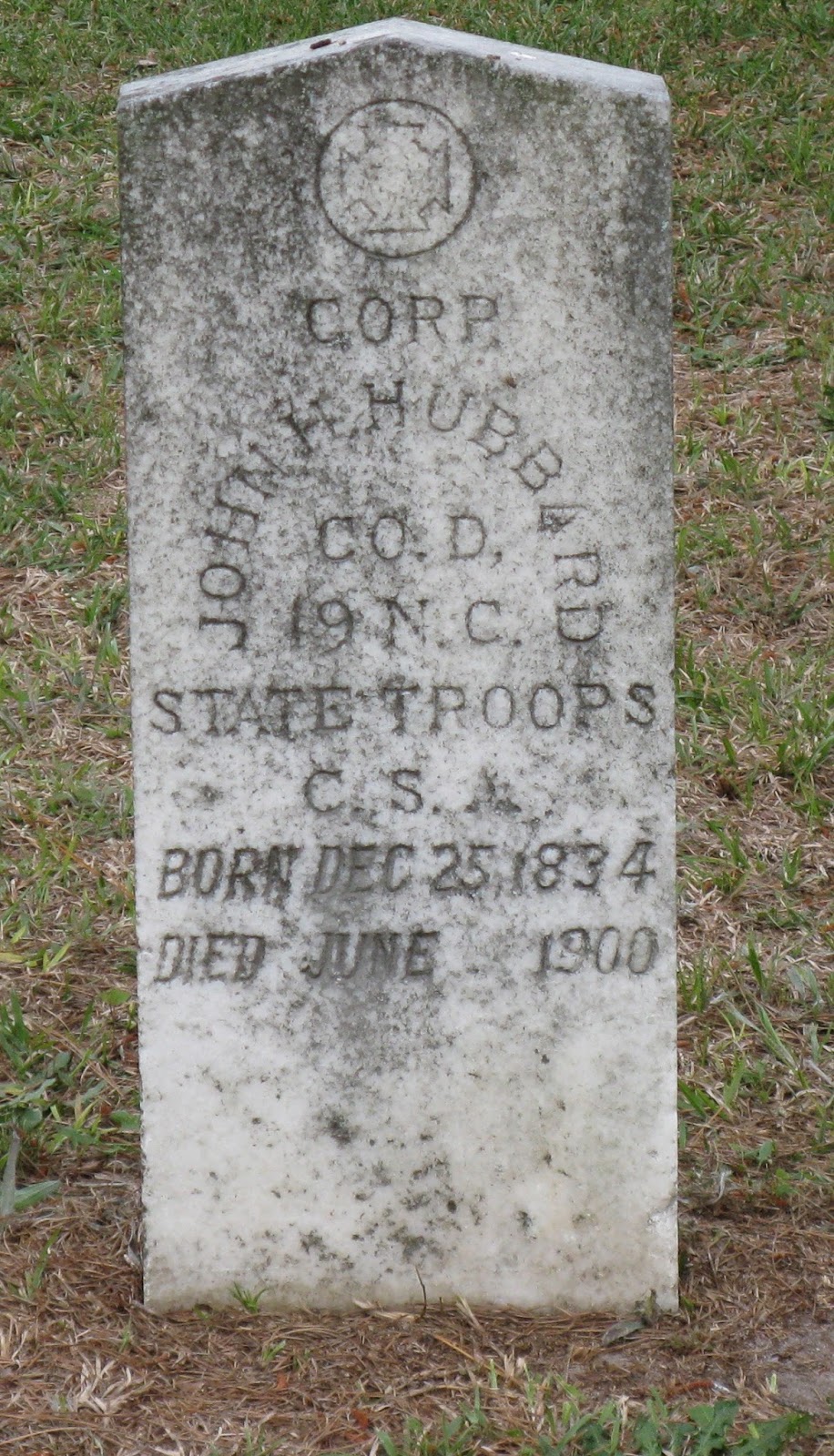
Our branch of the Hubbard family migrated from England and settled in New England sometime during the early colonial period.  The first Hubbard in our line to settle in North Carolina was a man named John Horace Hubbard, born on Christmas day, 1834, in the vicinity of Portland, Maine.  John Horace, or "Harry" as he was called, appears to have been the only son of John and Harriet Hubbard.

John Hubbard was Harriet LeFavour Fogg's second husband, and little is known today of his life or death. He is believed to have been born in what is now York County, Maine, soon after the turn of the nineteenth century.  Seamanship and other maritime activities were common occupations for men living in coastal New England at that time, and many who left to work at sea never returned.  Such is believed to have been the fate of Harry's father, John, sometime prior to 1837.  

The 1850 census finds seventeen year old Harry living with his mother and an older half brother, James Fogg, in the home of a Portland wood dealer named Joseph White.  It is believed that Mr. White's wife was Harriet's daughter, Susan.  The same census lists both Harry and his brother as mariners.

Sometime between July, 1850 and December, 1852, Harry Hubbard moved to North Carolina.  Some researchers have theorized that Harry was shipwrecked off the coast of North Carolina and made his way up the Cape Fear River to Fayetteville, though I have seen no evidence to support or deny that possibility.

This is the point at which Harry is supposed to have committed a murder, possibly in Boston, Massachusetts, and found it necessary to "disappear," though no proof has ever been discovered to verify or deny this legend.

According to extensive research done by Beverly Hubbard Godfrey, Harry Hubbard married a woman named Jane Russell on December 15, 1852, in Cumberland County, NC, placing him squarely in North Carolina no later than that date.

We may never know exactly when or why Harry Hubbard gave up the mariner's way of life, or if there is any veracity to the homicide tale.  It's entirely possible that Harry's brother's death, in October of 1853, near Valparaíso, Chile, far from home and away at sea - his body never to return, just like Harry's father - had an impact on his decision to give up the seafaring life, although the date, several months after Harry's marriage in late 1852, would seem a bit late.

There appear to have been no children born to the marriage of Jane Russell and Harry Hubbard, and Jane must've met an untimely demise, because Cumberland County marriage records indicate that on June 17, 1860, Harry got married a second time; this time to a woman named Mary A. Winn.

Unfortunately, Mary died too.

Poor Harry, barely twenty-six years old, two dead wives in the ground; at least he still had no children.  According to 1860 federal census records, Harry was single again, and living in Fayetteville with a young black boy.  Harry Hubbard never owned any slaves, so his pre-emancipation relationship to this young man is not understood.  What is known is that on June 18, 1861, barely two months after first shots were fired at Fort Sumter, South Carolina, igniting the American Civil War, Private John H. Hubbard enlisted to fight for the Confederate States of America.

During the war, Harry served in the 19th Regiment of N. C. Troops, also known as the 2nd Regiment NC Cavalry, Company D of the Army of Northern Virginia.  He was captured somewhere in North Carolina on August 6, 1862, but was released at Aiken's Landing, James River, Virginia, about sixty days later.

On June 30th, 1863, Harry, now Corporal Hubbard, was captured again during battle near Hanover, Pennsylvania.  Again a prisoner of war, Harry eventually found himself inside the now infamous prison at Elmira, New York.  "Hellmira" operated for 370 days, from July 6, 1864 to July 11, 1865 and it had the highest death rate of any Union Army prison camp.

Documents indicate that Harry made his captors aware of his family connections in Maine, and expressed a desire to be sent there, but his pleas fell on deaf ears. Harry remained at Elmira until March 10, 1865, when he was transferred, again to James River, Virginia, and exchanged for Union prisoners of war.

On August 30, 1865, Harry married for a third and final time, to another Mary; Mary Ellen Talbot.  Ellen, as she was called, gave Harry nine children, five sons and four daughters, and it is from these roots in Cumberland County, North Carolina that the Hubbard family has grown.

By 1870, Harry and Ellen were living near Ellen's family, the Talbots, in Flea Hill township with their first three children. Harry's occupation is listed as farmer in the 1870 census, though they owned no property.  On November 17, 1880, Harry and Ellen purchased 308 acres from Henry Lily on the east side of the Cape Fear River, though it is suspected that the land was lost a few years later in what we would now call foreclosure.

Ellen died on November 8, 1882, having given birth to nine children, at the age of thirty-two.  Harry shows up again in the 1900 census, living with his daughter, Harriet, and his youngest son, Peter, in Carver's Creek Township. Harry died July 7, 1900 and was buried in Parker's Grove UMC cemetery, in Linden, NC.

The children of Harry and Ellen Hubbard were:

Friday, May 1, 2015

Thurman J. Hubbard, Jr., February 14, 1943 - April 30, 2015

Thurman James (Jim) Hubbard, Jr., 72,  of 2940 Hickory Tree Road, Winston-Salem, NC, lost his life to cancer on the morning of April 30, 2015. Jim was born February 14, 1943 in Sampson County North Carolina to Lillian Maria Beazley and Thurman James Hubbard, Sr., and was the older brother of Robert L. Hubbard (deceased), and Jeffrey L. Hubbard of Shallotte, NC.

Jim was a graduate of James A. Gray High School, class of 1961, and attended Gaston Technical College. He married Brenda Coltrane on July 7, 1962. The young couple traveled the country for several years while Jim worked for Western Electric on missile defense projects. After returning to North Carolina in the mid-1960s, Jim got a job with Xerox where he worked for twenty-two years before leaving to establish Hubbard Tax Service in 1986. In the nearly thirty years since, Jim and Brenda made many deep and lasting friendships helping their neighbors deal with the only thing more certain than death: taxes.

Jim loved horses, and all things western. He was always up for a good cowboy movie, and enjoyed travelling the Blue Ridge Parkway with Brenda in their RV, trading stories around a campfire, watching his Panthers play football, and driving his tractor. He was a connoisseur of fine barbecue and Krispy Kreme donuts. He was proud of the accomplishments of his sons, and prouder still of his grandchildren. He will be missed by all who knew him.

Jim is survived by his wife, Brenda, his brother Jeff, two sons, Thurman J. Hubbard III (Diane) of Ramseur, and Bryan E. Hubbard (Carrie) of Winston-Salem, one granddaughter, Sheri-Lyn E. Hubbard of Boone and one grandson, Thurman J. Hubbard IV of Ramseur.

In lieu of flowers and a funeral, the family suggests memorial donations to the charity of your choice. The family will host an informal memorial gathering at the home on Saturday, May 9, from 4 - 8pm for food, fellowship, and remembrances, so bring a chair and an appetite for barbecue and donuts and join us in celebrating the life of Jim Hubbard.