Start here, or read the most recent posts below.

Beginnings

Thursday, August 3, 2017

An incomplete sketch of the family of Trudy Cochran Coltrane

Trudy Cochran Coltrane (1915-2000)
The maternal side of my mom's family were the Cochrans and the Farmers. Vernon Coltrane met Trudy Cochran while singing in a choral group while both were students at Guilford College.  Both received degrees and were married the following year, in 1938.

Trudy, as our grandmother preferred to be called, was a native of western Pennsylvania, transplanted to Kernersville, North Carolina when she was a young girl. She was the second youngest of four surviving children of Dr. Ira Lee Cochran and Luella Coral Farmer..

In 1929, Trudy's father, Dr. Ira Lee Cochran, Sr., died of a stroke at fifty-six years old.  Trudy was fourteen years old. Dr. Cochran left each of his children $1000; a sum equivalent to about $14,000 in 2017.

Trudy appears to have used her inheritance well.  She graduated from Guilford College and taught school in Greensboro public schools for decades, enriching the lives of hundreds of students.

Trudy's mother, Luella Farmer, was born September 15, 1878, in Westmoreland County, Pennsylvania, the eldest daughter of Frank Farmer and Martha Bankert. After Ira died in 1929, Luella and her children supported themselves by selling produce and flowers they grew on the small farm Ira had established before he died.

Luella was born into relative wealth, in the home of Frank A. Farmer and Martha Jane Bankert, and her marriage to Dr. Cochran kept her in relative comfort well into her forties, when Ira and Luella, their children, Ira Lee, Jr, Trudy, Jean, and Aline, who was a young adult with small children of her own, as well as Ira's sister Jesse, and her husband, James McCorkle, migrated south together to Kernersville, North Carolina.

A small a collection of watercolor paintings made by Luella Farmer Cochran exists today. She was a skilled watercolorist with a keen eye for detail and a steady hand. She died on July 1, 1967, at eighty-nine years old.

Trudy's grandfather, Luella's father, was Frank Anson Farmer, a mercantilist and "farmer".  Unlike most of our other ancestors who farmed for a living, Frank Farmer was an industrialist; he owned a large farm where many people were employed. In later life he helped establish the Jersey Flakes Food Company, and served as treasurer for a time
"The Jersey Cereal Food Co. was organized there in 1903 with $200,000 capital for the manufacture and distribution of a breakfast cereal called "Jersey Flake." A three-story brick building was erected about a mile south of Irwin near Hahntown at what became known as Cereal, Pa., production began the following year. Before the cereal plant was built, the area was farmland and was known as Lindencross.
"The new company was described in a 1904 booklet, published in conjunction with Irwin's 50th anniversary celebration: "All the experience of several years in the business is concentrated here, machinery being the best known and the factory in its entirety a model of its kind; automatic in its operation so that human hands do not touch the flakes from the grain to the packing in cartons. A new departure is that the supply of Jersey Flake is constantly crisp and fresh when it reaches the table, something that consumers appreciate and show it by the big demand."
"The first company president was John Kerr. He was soon followed by Chester D. Sensenich as president with Frank A. Farmer, treasurer, and R.J. Foster, secretary and manager.
Jersey Flakes promotional photo
"The plant burned down in 1906 and was replaced by a larger one in 1907. It was further expanded in 1908 and 1912 with a power plant added in 1920. Jersey Corn Flakes and Wheat Flakes, along with some related products, were manufactured in the four-story, 400-foot-long facility.
"Frank Farmer also served as Cereal's postmaster. A post office was located in the Jersey Cereal Food Co.'s general office building. It operated from Nov. 13, 1907, to Aug. 31, 1920 when it became a rural branch of the Irwin Post Office until it closed on April 30, 1937.
"The Jersey Cereal Food Co. was a very successful operation. At one time, it was the largest cereal manufacturing company in Pennsylvania. Its products were sold throughout the country. The company, known for being progressive, was one of the first to ban cigarette smoking and the use of alcohol by its employees."
Luella Farmer Cochran
Luella was in her forties and had been married to Dr. Cochran for many years by the time her father died in the summer of 1921. A few years after that, she and Ira migrated south, to Kernersville, North Carolina.

Ira's father, Robert John Cochran, was born near Charlotte, North Carolina, on July 27, 1846, and enlisted in the Confederate army during the Civil War. How he ended up married to Mary Evangeline Fleming, Ira's mother, and living out his days in Pennsylvania has been the subject of much speculation.

Sunday, July 16, 2017

Militant unionists in the Quaker Belt.

Recent events call into question our true history, with many people, ignorant of their own heritage and enflamed by those who would capitalize on such ignorance and the rage many feel today t their seeming economic helplessness.  At least some of my ancestors were Quakers and militant unionists, as were most people living in what is today Randolph County, North Carolina. Unfortunately, many have forgotten, or never knew.


Sunday, March 19, 2017

Thurman James Hubbard, Sr. (March 20, 1917 - March 2, 1987)

Thurman James Hubbard, the eldest surviving child of Willie and Carrie Hubbard, was born on March 20, 1917. The Willie Hubbard family was a fairly typical farming family of the era and region, neither very wealthy nor particularly poor, and it can be safely assumed that Thurman spent many seasons working alongside his father in the fields.

Thurman attended public school up to the ninth grade, but dropped out to pursue farming.  He enlisted in the army at age twenty-one, serving as a cook in the Panama canal zone from May 26, 1938 to August 13, 1940.  Thurman often explained that he was tricked into enlisting with promises of sunny beaches and beautiful native women; "the sunshine was liquid and the natives were black!"

Upon leaving the army, Thurman returned to Stedman, where he courted and married Ms. Lillian Maria Beazley, daughter of Miss Jennie and the late Capt. Harry Beazley, in a ceremony held in Miss Jennie's house, which stood in the woods behind Magnolia Baptist Church. The couple, along with Miss Jennie, settled in Fayetteville, where Thurman found work at the local Veterans Hospital as a cook and meat cutter through WWII and the late 1940's.  Jennie lived with Thurman and Lillian for the rest of her life, dying in 1984 at 94 years old.

During their time in Fayetteville two sons were born to Thurman and Lillian.  My father, Thurman James, Jr., (Jimmy) was born on St. Valentine's Day, 1943.  His younger brother, Robert Leslie (Bobby) arrived in June of the following year. The boys, both now deceased, were born sixteen months apart.

While the boys were still very young, Thurman and Lillian decided their best prospects for the future lay somewhere beyond Fayetteville; the family relocated to Winston-Salem sometime around 1950.  One of Thurman's younger brothers, Lewis, also moved to Winston-Salem around that time, and founded a company called Hubbard Realty.  One of the early commercial properties Lewis bought was a small neighborhood grocery store on Stockton Street, on the south side of town. Thurman and Lillian operated the store for several years, with Thurman cutting meat, and Lillian tending the counter. Granny, as Miss Jennie became known in later life, looked after the boys.

In 1957 Thurman and Lillian produced their last child, Jeffrey Lee Hubbard, and in 1958, purchased a home at 2645 Patria Street, around the corner from the little store on Stockton. Both older boys spent time working in the store, and sometime about 1960, Brenda Sue Coltrane, daughter of Vernon and Trudy Coltrane of Greensboro, found herself in the neighborhood, visiting her aunt Aline Murphy, who lived across the street from the Hubbards, and was sent to that store on an errand for the purpose of introducing her to the young man behind the counter, Jimmy Hubbard. (The set-up must have worked; I am the proof.)

Some time after moving to Winston-Salem, Thurman left running the store to Lillian and began building houses and doing home repair work, and became fairly prosperous for a while, but after several years deteriorating health forced him to slow down. He spent the remainder of his working life performing maintenance on his brother's rental properties.

In his spare time, Thurman liked fishing. He also planted a big garden at Jimmy's home on Hickory Tree Road, in the Arcadia community south of Winston-Salem, where I grew up. 

Thurman was a lifelong, fundamentalist Bible-believing, Southern Baptist Christian.  He was appointed a Deacon of the congregation, one of the proudest moments of his life, a few years before he died.

Sometime in early 1985, Thurman was diagnosed with lung cancer. After undergoing more than nineteen months of radiation, surgery and chemotherapy treatments, the cancer finally won. Thurman died on the evening of March 2, 1987.  I withdrew from Western Carolina University the following morning and headed for home, hoping for a last visit, not knowing it was already too late.

As of this writing there have been four successive generations of first born males in our family named Thurman James Hubbard. I, Jay, am the third and eldest living now. My son, Jayson, is the the fourth and last, so far.

Tuesday, January 3, 2017

How the Hubbard and Bryant families of Cumberland County, NC are related.

John Edward Hubbard
1867-1926
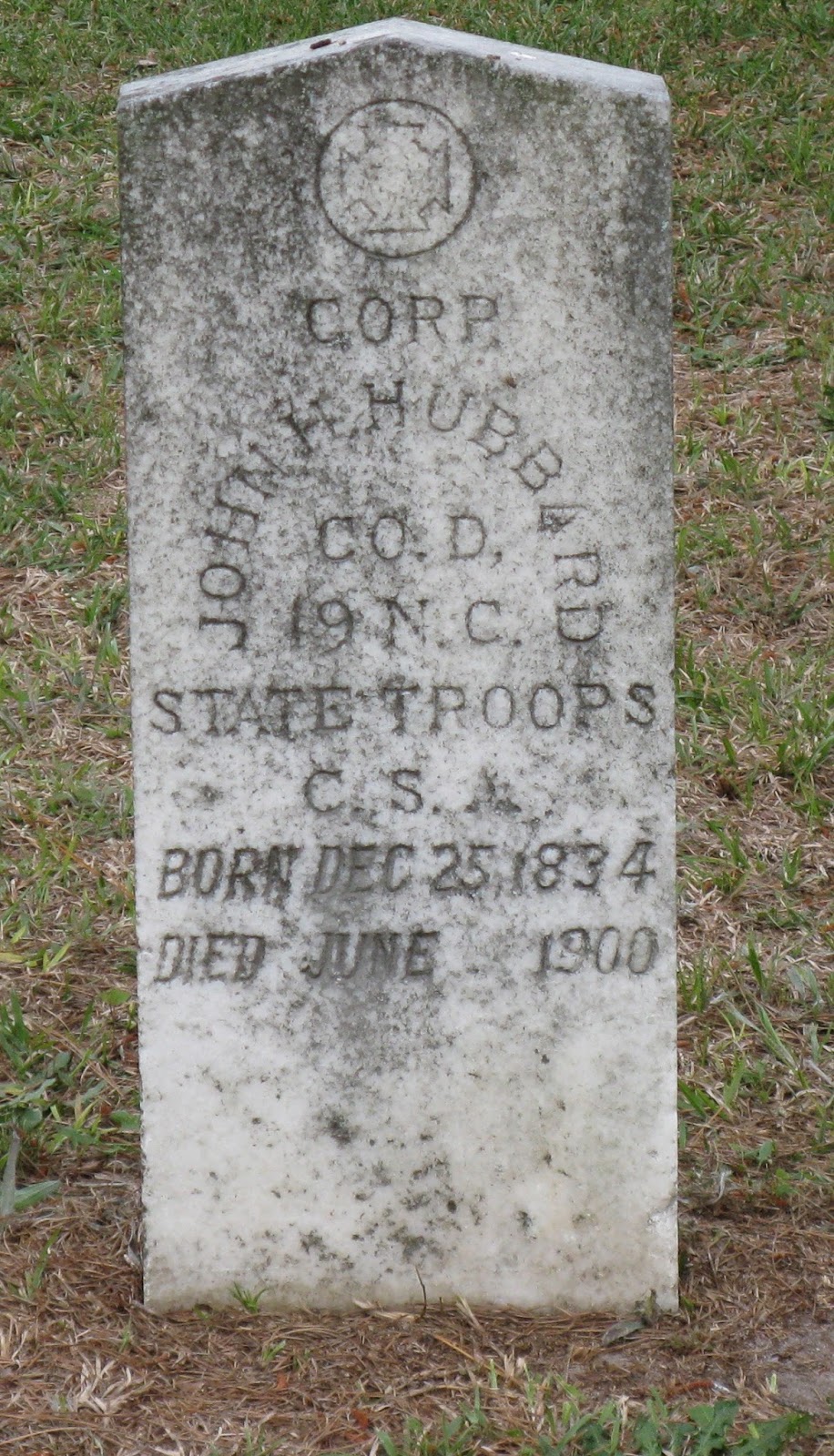
My branch of the Hubbard family arrived in North Carolina a few years prior to the Civil War.  My grandfather's great-grandfather, John Horace Hubbard, was a Yankee mariner who immigrated to North Carolina from Maine in the early 1850s.  Harry, as he was known, even enlisted and fought for the Confederacy during the Civil War.

After the war Harry returned to Cumberland County, married a local girl named Mary Talbot,  and took up farming.  Harry Hubbard fathered nine children before his life ended on July 7, 1900.

Mary Bunce Hubbard
1869-1914
Harry's eldest surviving son, John Edward Hubbard, was born on October 1, 1867, the first of ten siblings born to Harry and Mary Hubbard.  The family lived at Flea Hill, North Carolina during those years.  When John was fifteen years old his mother died.  He likely took up farming with his father full time then, if he had not done so before.

On October 24, 1889, Coonie, as he was called, married Mary Ellen Bunce.  Mary and Coonie's first child, Walter Lee, was born January 1, 1891, and died a few months later on April 17.  The following year, on May 25, 1892, a second son, Willie James Hubbard, was born, the first of ten children who survived to adulthood.  Then, on May 18, 1914, at forty-five years old, her youngest child still in diapers.

Some among the descendants of John Edward and Mary Bunce Hubbard have suggested that Mary may have suffered from some form of depression.  Mary may also have taken her own life.

Mary and Coonie lived near the family of Leonard and Ellen Bryant, near the town of Stedman,
Willie James Hubbard
1892 - 1979
North Carolina.  It has been alleged by some family members, and cannot be proven one way or another at this point, that Coonie may have been having an affair with Len Bryant's eldest, adult daughter, Ardelia.  Some theorize that Mary killed herself upon discovering Coonie's infidelity with a woman ten years her junior.

Soon after Mary's death, John Edward Hubbard married Ardelia Bryant.  The couple had two sons, only one of which survived to adulthood.  He and his mother both eventually relocated to California where they died and were buried.

John Edward 'Coonie' Hubbard died the day after Christmas, 1926, at fifty-six years old.

Thurman & Lillian Hubbard
Feb.16, 1941
Coonie's neighbor, Len Bryant, had another daughter readers of this space have already met, Jennie Bullock Bryant.

When Jennie's sister Delia married Coonie Hubbard in February of 1915, that made Jennie the last of the Bryant daughters remaining single.

By December of the following year, four days before her twenty-seventh birthday, Jennie had run off to California and married a man eleven years her senior, just returned from many years' service in the Philippines.

By 1920, Jenny had returned home to Stedman, with an infant son and a terminally ill husband in tow.  She became a widow just before the end of 1921, months after giving birth to a daughter she named Lillian Maria.

Lillian grew up and married Coonie Hubbard's son Willie's oldest boy, Thurman James Hubbard.  They moved from Fayetteville to Winston-Salem, North Carolina in 1950, when my father, Thurman, Jr. was about seven years old.

Thursday, December 29, 2016

My earliest memories.

The earliest really distinct memories I have go back to about 1969, or maybe late 1968.  I would have been two and a half to three years old.  My parents lived in a house on Romara Drive, then a few miles outside Winston-Salem off of Jonestown Road.  The house was a little brick ranch with a carport on the left side.

They tell me I watched Neil Armstrong walk on the moon.  I have no recollection of that event, but I do have a few fragmentary memories of that time:  playing with kittens behind the carport and discovering, from a bad rash I developed that I was allergic to them, and the time we stopped and looked at a large snapping turtle we found in the road one day, or watching Tom & Jerry cartoons one morning - must've been Saturday - with my dad.  He always like Tom & Jerry the best; said it was pure entertainment, whatever that means.

I can remember my mother rocking me in a big, white, probably leather chair, reading to me before bed, and I remember moving day, 1969, when we moved to the Hickory Tree Road place where some combination of us would remain, in one house or the other, until 2015.  I remember getting into the covered back of my grandpa's truck that day, and getting my finger smashed when the door closed.

But my earliest really distinct memory is of lying awake in my crib one night.  I remember hearing the Doc Severinsen Orchestra playing the theme of The Tonight Show, and Ed McMahon's unmistakable voice saying, "Heeeerrrre's, Johnny!"  A little later, I remember hearing my dad literally rolling in the floor with laughter at some hilarity.
Severinsen, Carson, and McMahon

I have a few other memories associated with that time and place.  One in particular having to do with potty training.  Apparently, one night I was asked or expected to sit on the potty chair in the living room.  These were the days before video recording or being able to stop playback of a program on television, so I guess the idea was to have me crap in the front room so as not to miss whatever they were watching.

Well, I was having none of that.  I couldn't tell them then, I guess, but I remember being ashamed having to pull off my pants and sit on the bathroom thing in the living room.  Nobody else did there business in there, so why did I have to. It was embarrassing and humiliating - to a three year old nonetheless - and I balked and resisted.  The first of many loud disputes between two of the hardest heads ever to walk the earth.

Oh, and I remember falling down the basement stairs, and the way the floor looked coming up at me.

Kinda wish I could forget that.

Wednesday, December 21, 2016

Why genealogy?

This work is the result, so far, of a lifetime of amateur, and often sloppy - on my part - genealogy research.  My interest in the subject of my family's history began, like it did for many other Americans of a certain age, with the broadcast of Alex Haley's Roots on television in 1977.  I didn't realize it back then, but as a white kid living within about 100 miles of where my parents' ancestors had settled, I had a big head start on finding my people because my ancestors kept pretty decent records from the Civil War onward, and in some cases, much further back.
Willie and Carrie Hubbard Family - Fiftieth Wedding  Anniverary

Now, nearly forty years later, I have become the keeper of relics in my family.  Out of the huge family I once saw at reunions three or four times each year, among my grandparents' generation, including all of their siblings and spouses - more than fifty people - all but four are gone from this earth; most for many years now.

At the time of my birth, fifty years ago, five of my eight great-grandparents were still alive.  By the time I turned ten that number had dropped to two.  The last of my of my great-grandparents, and the only one I truly remember, was Jennie Bryant Beazley. She died in 1984, aged 94 years.

The first of my grandparents, Thurman Hubbard, Sr., died a few years later, in 1987, from asbestos related lung cancer; I was twenty.  I thought I took it hard at the time, but the hindsight of thirty years informs me otherwise.  My three other grandparents all lived until the year 2000 or later.

I have been truly blessed, if that is the appropriate word, to have lived a good portion of my life while these people walked the Earth with me.  Many are not so fortunate.   I regret that the family my children have been born into is so much smaller and further flung in this generation.  Such is the nature of our time.

In 2015 I lost my father.  He was 72 years old; a victim of cancer, a stubborn disposition, and a profit-driven medical system.  I thought I knew bout grief before, but I was blissfully ignorant.

My father and I never appeared close, in public or private, and in many ways we weren't, but I have felt his absence like a black hole ripped in the universe, threatening to suck me and all I care about inside out, every day since April 30, 2015.  Many times during the past couple of years I thought I was losing my mind - and probably did a time or two - and feared I'd have to live the rest of my days in that bad mental place.

I've spent almost fifty years collecting documents, artifacts, and statistics about a bunch of dead people, without ever bothering to try to really get to know who they were as well as I might have while they were living. In short, I feel as if  I've wasted a lifetime missing the forest on account of all the trees in my path.

The deep, rich sense of belonging I felt growing up as a member of two large yet tight-knit North Carolina families is something my children and their immediate cousins will never experience, and no amount of education, travel, or other cultural experiences can ever replicate it for them.  I hope that by committing these thoughts and images to writing - perhaps even a printed book one day - my grandchildren will know me and the people I came from, and in so doing, maybe better understand themselves.

Saturday, December 17, 2016

Len and Sallie, the Bryant family that wasn't.

Thurman J Hubbard III w/ Jennie Beazley, 1966
My great-grandmother, Jennie Beazley, my dad's maternal grandma, always maintained that her father had donated the land upon which Magnolia Baptist Church stands, however, the authors of, "A Guide to Historic Churches of Cumberland County," offer a slightly different account.
"On November 13, 1855, Randall McDaniel deeded two acres to William Bryant, Hardie Jones and Owen Jones, trustees for the Baptist Meeting House on Buck Creek. The original building... was located in front of the present church building."
Leonard Bryant would have been about eight years old when Magnolia Church was being organized.  He obviously didn't contribute any land, nor did anyone else in the family, but his father, William James Bryant, is more than likely the William Bryant mentioned in the quote above as a founding trustee of the church.  William's occupation is listed in the 1860 census as constable.
1860 census

The William J. and Nancy Jones Bryant family probably lived fairly close to the site of the modern church, given its close proximity to the Bryant family cemetery, less than a mile south and across the road.

The small house that the community built many years later for Jennie and her two small children, after Captain Beazley's untimely death, stood near the western edge of a large agricultural field behind where the modern church stands today.  The last home of Jennie's youngest brother, John Robert Bryant, still stands adjacent to the family cemetery.

Jennie Beazley's claim that her father gave the land where Magnolia Baptist church stands today does not hold water under scrutiny, but the information discovered in debunking that myth leads us to another story, perhaps more interesting and certainly more important to Leonard Bryant's descendants today.

Remember Hardy Jones, one of the other two founding trustees of Magnolia church?  Hardy and his wife, Martha Jessup Jones were farms who lived and raised eleven children not too far from Magnolia Church.  The children of Hardy and Martha Jones were:

Marriage certificate, Len Bryant and Sallie Jones
  Mary Jones (1843 - 1932)
  Owen Dallas Jones (1846 - 1864)
  Marshall Jones (1848 - 1921)
  Sallie Jones Bryant (1850 - 1873)
  Salome Catherine Jones Bryant (1853 - 1892)
  William Judson Jones (1855 - 1929)
  Rebecca E Jones (1857 - 1879)
  Theodosia Jones (1860 - 1886)
  Harriet Jones Strickland (1862 - 1954)
  Alice V. Jones Godwin (1865 - 1951)
  Carson E Jones (1869 - 1906)

Hardy Jones was Nancy Jones Bryant's brother;  Hardy and Nancy's children's were first cousins.

On March 11, 1869, Leonard Bryant married his first cousin, Sallie Jones.  A few years later, Len's younger brother, John Bunyon Bryant, followed suit, marrying Sallie's younger sister, Salome Catherine Jones.  That pair produced three daughters, all who lived to adulthood, married and had families of their own.

Len and Ellen Bryant, circa 1878
Len and Sallie were not so blessed.  Sallie died in childbirth, along with her child, on July 12, 1873.  Len must have been devastated, having lost both his father and his bride within a five year period, but by 1878, Leonard had found a new bride, this time a bit further from home.

He married Ellen Virginia Smith, a daughter of Thomas Melvin Smith and Harriet Newell Harvey Smith of Bladen County, North Carolina, and she bore him eight children. Six of those children survived to adulthood.  Len and Ellen had eight children, six of which survived to adulthood.

  Haywood Harvey Bryant (1878 - 1965)
  Ardelia Lee Bryant Hubbard (1880 - 1967)
  Mary Newell Bryant (1883 - 1898)
  Ila Eugenia Bryant Weeks (1885 - 1965)
  William Thomas Bryant (1887 - 1887)
  Jennie Bullock Bryant Beazley (1889 - 1984)
  Lenora Irene Bryant Draughon (1892 - 1960)
  John Robert Bryant (1895 - 1990)

Sallie Jones gets little mention at most family gatherings, but had she lived, these stories wouldn't be about any of us.

Thursday, December 15, 2016

How the Hubbards came to North Carolina.

I grew up hearing whispered tales about how, "the first Hubbard in North Carolina was a sailor, forced to jump ship after killing a man in a card game."  There may be a few kernels of truth buried somewhere in that myth, or not, but so far the evidence for that is inconclusive at best.  

Our branch of the Hubbard family migrated from England and settled in New England sometime during the early colonial period.  The first Hubbard in our line to settle in North Carolina was a man named John Horace Hubbard, born on Christmas day, 1834, in the vicinity of Portland, Maine.  John Horace, or "Harry" as he was called, appears to have been the only son of John and Harriet Hubbard.

John Hubbard was Harriet LeFavour Fogg's second husband, and little is known today of his life or death. He is believed to have been born in what is now York County, Maine, soon after the turn of the nineteenth century.  Seamanship and other maritime activities were common occupations for men living in coastal New England at that time, and many who left to work at sea never returned.  Such is believed to have been the fate of Harry's father, John, sometime prior to 1837.  

The 1850 census finds seventeen year old Harry living with his mother and an older half brother, James Fogg, in the home of a Portland wood dealer named Joseph White.  It is believed that Mr. White's wife was Harriet's daughter, Susan.  The same census lists both Harry and his brother as mariners.

Sometime between July, 1850 and December, 1852, Harry Hubbard moved to North Carolina.  Some researchers have theorized that Harry was shipwrecked off the coast of North Carolina and made his way up the Cape Fear River to Fayetteville, though I have seen no evidence to support or deny that possibility.

This is the point at which Harry is supposed to have committed a murder, possibly in Boston, Massachusetts, and found it necessary to "disappear," though no proof has ever been discovered to verify or deny this legend.

According to extensive research done by Beverly Hubbard Godfrey, Harry Hubbard married a woman named Jane Russell on December 15, 1852, in Cumberland County, NC, placing him squarely in North Carolina no later than that date.

We may never know exactly when or why Harry Hubbard gave up the mariner's way of life, or if there is any veracity to the homicide tale.  It's entirely possible that Harry's brother's death, in October of 1853, near Valparaíso, Chile, far from home and away at sea - his body never to return, just like Harry's father - had an impact on his decision to give up the seafaring life, although the date, several months after Harry's marriage in late 1852, would seem a bit late.

There appear to have been no children born to the marriage of Jane Russell and Harry Hubbard, and Jane must've met an untimely demise, because Cumberland County marriage records indicate that on June 17, 1860, Harry got married a second time; this time to a woman named Mary A. Winn.

Unfortunately, Mary died too.

Poor Harry, barely twenty-six years old, two dead wives in the ground; at least he still had no children.  According to 1860 federal census records, Harry was single again, and living in Fayetteville with a young black boy.  Harry Hubbard never owned any slaves, so his pre-emancipation relationship to this young man is not understood.  What is known is that on June 18, 1861, barely two months after first shots were fired at Fort Sumter, South Carolina, igniting the American Civil War, Private John H. Hubbard enlisted to fight for the Confederate States of America.

During the war, Harry served in the 19th Regiment of N. C. Troops, also known as the 2nd Regiment NC Cavalry, Company D of the Army of Northern Virginia.  He was captured somewhere in North Carolina on August 6, 1862, but was released at Aiken's Landing, James River, Virginia, about sixty days later.

On June 30th, 1863, Harry, now Corporal Hubbard, was captured again during battle near Hanover, Pennsylvania.  Again a prisoner of war, Harry eventually found himself inside the now infamous prison at Elmira, New York.  "Hellmira" operated for 370 days, from July 6, 1864 to July 11, 1865 and it had the highest death rate of any Union Army prison camp.

Documents indicate that Harry made his captors aware of his family connections in Maine, and expressed a desire to be sent there, but his pleas fell on deaf ears. Harry remained at Elmira until March 10, 1865, when he was transferred, again to James River, Virginia, and exchanged for Union prisoners of war.

On August 30, 1865, Harry married for a third and final time, to another Mary; Mary Ellen Talbot.  Ellen, as she was called, gave Harry nine children, five sons and four daughters, and it is from these roots in Cumberland County, North Carolina that the Hubbard family has grown.

By 1870, Harry and Ellen were living near Ellen's family, the Talbots, in Flea Hill township with their first three children. Harry's occupation is listed as farmer in the 1870 census, though they owned no property.  On November 17, 1880, Harry and Ellen purchased 308 acres from Henry Lily on the east side of the Cape Fear River, though it is suspected that the land was lost a few years later in what we would now call foreclosure.

Ellen died on November 8, 1882, having given birth to nine children, at the age of thirty-two.  Harry shows up again in the 1900 census, living with his daughter, Harriet, and his youngest son, Peter, in Carver's Creek Township. Harry died July 7, 1900 and was buried in Parker's Grove UMC cemetery, in Linden, NC.

The children of Harry and Ellen Hubbard were:

Friday, May 1, 2015

Thurman J. Hubbard, Jr., February 14, 1943 - April 30, 2015

Thurman James (Jim) Hubbard, Jr., 72,  of 2940 Hickory Tree Road, Winston-Salem, NC, lost his life to cancer on the morning of April 30, 2015. Jim was born February 14, 1943 in Sampson County North Carolina to Lillian Maria Beazley and Thurman James Hubbard, Sr., and was the older brother of Robert L. Hubbard (deceased), and Jeffrey L. Hubbard of Shallotte, NC.

Jim was a graduate of James A. Gray High School, class of 1961, and attended Gaston Technical College. He married Brenda Coltrane on July 7, 1962. The young couple traveled the country for several years while Jim worked for Western Electric on missile defense projects. After returning to North Carolina in the mid-1960s, Jim got a job with Xerox where he worked for twenty-two years before leaving to establish Hubbard Tax Service in 1986. In the nearly thirty years since, Jim and Brenda made many deep and lasting friendships helping their neighbors deal with the only thing more certain than death: taxes.

Jim loved horses, and all things western. He was always up for a good cowboy movie, and enjoyed travelling the Blue Ridge Parkway with Brenda in their RV, trading stories around a campfire, watching his Panthers play football, and driving his tractor. He was a connoisseur of fine barbecue and Krispy Kreme donuts. He was proud of the accomplishments of his sons, and prouder still of his grandchildren. He will be missed by all who knew him.

Jim is survived by his wife, Brenda, his brother Jeff, two sons, Thurman J. Hubbard III (Diane) of Ramseur, and Bryan E. Hubbard (Carrie) of Winston-Salem, one granddaughter, Sheri-Lyn E. Hubbard of Boone and one grandson, Thurman J. Hubbard IV of Ramseur.

In lieu of flowers and a funeral, the family suggests memorial donations to the charity of your choice. The family will host an informal memorial gathering at the home on Saturday, May 9, from 4 - 8pm for food, fellowship, and remembrances, so bring a chair and an appetite for barbecue and donuts and join us in celebrating the life of Jim Hubbard.

Wednesday, February 25, 2015

Happy birthday Grandma!

Exactly one hundred years ago today, the first of my four grandparents was born.

Gertrude (Trudy, she hated to be called Gertrude) Coral Cochran was born in Westmoreland County, Pennsylvania. Her father was a dentist, Dr. Ira Cochran; her mother, Luella Coral Cochran, was the eldest daughter of Frank and Martha Jane (Bankert) Farmer.

Trudy was the third surviving child of five; one older sister died before age five. Interestingly, the four children who survived to adulthood were born five years apart. The sister who died, Hope, was born less than two years after the eldest daughter, Aline. I suspect, but cannot prove, that the loss of their second child caused Ira and Luella to deliberately spread the other births apart. Perhaps childbirth was harder on Luella than it is on most women.

At some point, probably before she was ten years old, the Cochrans relocated to Kernersville, NC, ostensibly because the colder northern climate was causing Ira to have health problems. Ira's sister, Jesse, and her husband also moved south at that time. That family's name was McCorkle. Family lore has it that the family lived in a chicken house when they arrived, while waiting for their home to be completed.

When Trudy was thirteen years old, Dr. Cochran had a stroke and died, leaving Luella to finish raising the youngest three children on her own. Census records indicate that she took up "truck farming" to support herself and the children.

Trudy's oldest sister Aline and her children had moved south with the rest of the family, and lived nearby. Another sister, Jean, five years older than Trudy became a librarian in Augusta, Georgia, where she was instrumental in the growth of that city's public library system in the later half of the 20th century. The youngest child, Ira Lee, Jr. served in the Merchant Marines during the war and became an independent truck driver thereafter.

Trudy graduated from Guilford College in about 1936 or 37, and went to work teaching in Greensboro and/or Guilford County schools, a career that lasted well into the 1970s. She spent most of those years, if not all of them, teaching fourth grade.


In 1938 Trudy married Vernon E. Coltrane, a scion of one of the oldest families in the region. The union produced one child, my mother, before Vernon left to serve in India during WWII, followed by three more, a daughter and two sons after the war. From these children came six grandchildren, and as of last count, six great-grandchildren.

Grandma Coltrane left us on June 11, 2000. She died quietly of a heart attack while riding to church with Vernon and a friend. Gone but never forgotten, her life continues to inspire her descendants to this day.

Happy birthday, Grandma, we miss you.

Wednesday, February 4, 2015

As I was saying...

I have maintained for many years that if you live in the same state where at least one side of your family has lived for more than a few generations (or a century), then most of the people you meet in the course of your daily life are your cousins. Today, I proved it.

A guy called me just before noon today to ask about my services (sorry, no further details about my biz here). I had some free time this afternoon so I agreed to come to his house after lunch and take care of his problem. He gave me the address, about 20 miles away, in a part of the county where I know my mother's people settled before the Revolutionary War, so I wondered if he was 'one of ours'.

When I arrived he came out to meet me, and showed me his problem. I got started on the solution and we proceeded to make small talk while I worked. Soon enough I found an opportunity to ask him if his family was from around here. He told me that his father, now deceased, was born and raised on the property. Then I asked him if he was related to any of the Coltrane family around the area, and he confirmed my suspicions.

My mother was born a Coltrane, so I replied, "Nice to meet you, cousin."

We proceeded to drop names of people we each hoped the other might know, but as I suspected, the connection is too far back to grasp without digging through a few documents. At some point my new found cousin said, "I wish my mother was here, she'd know some of these names for sure."

And then, as if by magic, his mother drove up the driveway.

We talked and traded names some more, and finally found a few descriptions that seem to match. We never did figure out exactly how we are related, but we are, without a doubt related.

So remember, nearly everyone you meet every day is very likely a distant cousin of yours, either by blood or marriage, and probably a lot closer related than you'd imagine. If more people would operate with that idea in mind, I think we'd see a lot more folks behaving like they really are their brother's keeper.

Sunday, February 1, 2015

What happened to Harry L. Beazley?

Over the years there have been more than a few debates and discussions of my great grandfather Harry L Beazley's demise. He entered Jennie Bryant's life, gave her two children, and was dead and gone, all in less than five years.

Harry even tried to re-enlist
from the mental hospital.
As noted previously, Harry had a hard time finding a job upon his arrival in North Carolina. When he did finally secure employment it only lasted about five months. Less than one week after leaving Erwin, Plant No. 2, Harry Beazley was hospitalized and would remain so until his death 26 months later.

Captain Beazley went insane, that much is undisputed. What we don't know for certain is why, but there are a number of possibilities worth considering.

We know Harry spent approximately ten years living in the Philippines, a tropical climate. We also know that Harry suffered repeated bouts of tropical sprue, a particularly nasty little disorder that causes malabsorbtion of nutrients from the gastrointestinal tract. There are several known causes of tropical sprue, but one, a protist indigenous to the Philippines was only discovered in the 1980s.  One of the less common symptoms of a long term case of sprue is, apparently, a form of dementia. Could that have been a contributing factor or even a primary cause?

The cause of death listed on the only document we have says simply, "paresis". Paresis of the insane was, in 1921, an incurable illness usually associated with syphilis. A treatment using penicillin was discovered less than five years after Harry's death. Had that treatment been discovered just a few years earlier, my family history would be a much different story.

Jennie Beazley with her children and
members of their families, about 1960.
Unfortunately, medical science of the early twentieth century was still light years behind our current knowledge. Maybe Harry had syphilis? Or maybe his dementia was a complication of his long battle with sprue? Or maybe it was something else entirely; early onset Alzheimer's anyone? PTSD? We will never know, but one thing is certain; Harry Beazley met a horrific and unfortunate end.

Harry and Jennie's second child, Lillian Maria Beazley, was born on July 8, 1921. If Harry was hospitalized in a mental institution from September, 1919 onward, how and when did Jennie become pregnant? Did this happen at the hospital during a visit? Were conjugal visits allowed? Was any sexual activity between Harry and Jennie mutually consensual? Was Lillian Beazley's conception an act of rape?

We will probably never have definitive answers for these and many other questions; all of the primary actors are long dead and gone now. Harry and Jennie Beazley's children grew up and married, producing six grandchildren and numerous great- and great-great grandchildren between them.

Saturday, January 31, 2015

San Francisco to Stedman in five short years.

In early 1917, Harry and Jennie Beazley set up housekeeping and began to settle into domestic life across the bay from the city of lights, San Francisco, in the vicinity of present day Hercules, California. Harry worked at the powder works and Jennie ran a small tobacco & sweets store.

As war in Europe dragged on, the United States was slowly being compelled to enter the conflict; Harry re-enlisted in August of 1917.  By then he was deaf in his left ear and again suffering from sprue. Within days he was honorably discharged due to his poor health. Harry was two months from his fortieth birthday.

HL and Lillian Beazley, ca. 1926
Sometime in the early autumn of 1918, Jennie must have discovered she was pregnant, much to the delight of the young couple. The year 1918 also brought the pandemic known as the Spanish Flu, an unusually deadly influenza pandemic, the first of the two pandemics involving H1N1 influenza virus. It infected 500 million people across the world, including remote Pacific islands and the Arctic, and killed 50 to 100 million of them—three to five percent of the world's population, making it one of the deadliest natural disasters in human history.

The pandemic was spread, in part, by soldiers returning home from Europe. According to Jennie Beazley, she was the only pregnant woman to contract the virus and survive in their county. She attributed her survival solely to Harry's care, but as she slowly recovered, Harry began to worry about his own health.

In March 1919, Jennie, roughly seven months pregnant, and her beloved Harry left California for her mother's home in Stedman, NC. Upon their arrival Harry found a job market that was difficult for a middle-aged man competing with thousands of much younger men returning from the war.

On April 20, 1919 things began to look up for the Beazley's when Harry found a job as a supply manager at Erwin Cotton Mills, Plant No. 2, located in the Harnett County town of Duke, NC (now called Erwin).  Less than a month later, Harry Leslie Beazley, Jr. (called simply HL his entire life) was born on May 14, 1919.

A second child, Lillian Maria Beazley, was born on July 8, 1921. According to Jennie, Harry asked that she be named for a favorite schoolteacher, Lillian. His choice of middle name, Maria, seems an obvious nod to his deceased first wife, "the Spaniard" Irene Santa Maria. Whatever joy the family felt at Lillian's birth must have been tempered by the uncertainty of their future. Harry was not in a good way and his health continued to deteriorate. He died at the Dorothea Dix Hospital in Raleigh, NC on November 21, 1921.

Wait, what? Yes, Harry Beazley died at the Dorothea Dix state hospital for the mentally insane just five years after returning from the Philippines, and less than four months after the birth of his daughter.

According to the 1920 census, taken on January 28, 1920, the household at that time consisted of Ellen Bryant (Jennie's mother), Jennie, HL (Harry Junior), Jennie's younger brother John Robert, and his wife, Margie. So by this time Harry must already have been institutionalized. Jennie would have been approximately two months pregnant with Lillian, placing her conception sometime in November, 1919.

The closest we have to a death certificate for Harry L. Beazley is a permit to move his corpse, but it lists, in the handwriting of the attending physician, the cause of death as paresis, which, given that the facility was a mental hospital, I take to mean general paresis of the insane, a condition that was incurable at the time

From Wikipedia:
Originally, the cause was believed to be an inherent weakness of character or constitution. While Esmarch and Jessen had asserted as early as 1857 that syphilis caused general paresis, progress toward the general acceptance by the medical community of this idea was only accomplished later by the eminent nineteenth-century syphilographer Alfred Fournier (1832–1914). In 1913 all doubt about the syphilitic nature of paresis was finally eliminated when Hideyo Noguchi and J. W. Moore demonstrated the syphilitic spirochaetes in the brains of paretics.
In 1917 Julius Wagner-Jauregg discovered that infecting paretic atients with malaria could halt the progression of general paresis. He won a Nobel Prize for this discovery in 1927. After World War II the use of penicillin to treat syphilis made general paresis a rarity: even patients manifesting early symptoms of actual general paresis were capable of full recovery with a course of penicillin. The disorder is now virtually unknown outside developing countries, and even there the epidemiology is substantially reduced.
Had this tale played out just a few years later, Harry Beazley might have been cured and lived a much longer life. Instead he died, leaving a widow and two small children nearly destitute.

After burying her husband in the family cemetery, Jennie was left with less than one dollar in her purse. She spent the next few months working to secure Captain Beazley's Spanish-American War veteran's pension. She would eventually prevail and collected this pension until her own death in 1984. Shortly after the death of Captain Beazley, the men of the community built a small home behind and across a field from where Magnolia Baptist Church stands today, on Bryant family land, using lumber supplied by Jennie's brother-in-law, John Edward Hubbard.

When Harry met Jennie.

On December 6, 1916, my great grandmother, Miss Jennie Bryant of Stedman, North Carolina became Mrs. Harry L. Beazley of San Francisco, California. My uncle, Jeff Hubbard, one of many members of my family who have generously shared the research they have done on our common ancestors, wrote an excellent synopsis of Harry and Jennie Beazley's story, so I'll let him tell it.

Captain Harry Leslie Beazley
Harry Leslie Beazley was born on October 5, 1877 on the farm of his parents, Williamson Clive Beazley and his wife, Charlotte Delanie Henry. Leslie, as he was called in the 1880 census, was born weeks before his father's 25th birthday. Delana, as his mother was called, was 21. He was their oldest child. The family lived on a farm near Forest City, in St. Francis County, Arkansas. The farm was located at a place known as Crowley's Ridge.

Williamson C. Beazley, was the oldest of ten children born to George Washington Beazley and Lucy FMichie. Census records show that William was born in Arkansas, his father is listed as born in South Carolina and his mother's birthplace as Tennessee. The same record indicates that Lucy was born in Louisiana and lists both parents as natives of Tennessee. 

Harry spent his first twenty years living on his father's farm. According to his widow, Harry wanted to go to medical school, but his father refused to send him. He moved to Tampa, Florida in early 1898, where he spent several months working as a bartender before he enlisted to fight in the Spanish-American War, serving in Company A of the First Regiment of Florida Volunteers. He was honorably discharged on December 3, 1898 at the war's end and mustered out at Tallahassee, Florida.

Corporal Beazley returned to his father's farm after discharge and remained for about six months. Farm life did not suit Harry; having seen the world, he developed a taste for adventure and exotic lands. On July 27, 1899, Harry reenlisted in the US Army, assigned to Company B of the Thirty-third Infantry of the United States Volunteers.

During the next nineteen months, Harry Leslie Beazley served with honor. His discharge papers indicate that he obtained the rank of Quarter Master Sergeant and participated in a number of skirmishes and other actions. He was a participant in the bombardment and landing at San Jacinto under General Wheaton on November 11, 1899. Master Sergeant's Beazley's discharge was dated February 5, 1901 at Manila.

Harry Beazley joined the Manila Police Force (run by US Army) on February 12, 1901. Patrolman Beazley then joined the ranks of the Philippine Constabulary being assigned duties at Leon, as of December 19th. Harry spent several years working for the Constabulary, being promoted to the rank of Captain and Inspector on March 26, 1906.

While living in the Philippines, Captain Beazley married a Spanish woman named Irene Santa Maria. She was a beautiful woman (there was a picture of her that Jennie Beazley had, that since her death has disappeared). She was an opera singer. Her devotion to Harry was less than that of her Spanish roots and he caught her passing information to a local priest, who in turn was passing the information on to rebels. Harry told Jennie the couple had divorced and that Irene Santa Maria was dead by October, 1906.
Among the stories of this period Miss Jennie used to tell was this one; one night Harry came in late and another soldier was drunk and asleep in his bed. Harry simply slept in the other soldier's bed and in the morning the soldier in Harry's bunk had had his throat cut. He believed his former wife was behind this attack, having recently separated from her.

Another story told was about traveling with guides through the jungle and reaching an area that seemed disturbed. The guides were leading him to a covered pit with stakes, meant for him to fall in. He claimed he threw the guides in the pit and let them meet the death they had planned for him.
Captain Beazley submitted his resignation from the Philippine Constabulary on May 20, 1907. He was very ill and spent most of the year of 1907-1908 in the American Hospital in Manila. He was being treated for tropical sprue, which is essentially a form of dysentery. Harry would be affected by bouts of sprue for the remainder of his life.

Over the next seven years, Harry Beazley held several positions in both the private sector and in civil service jobs in the Philippines. He worked as an auditor at the Singer Sewing Machine Company in Manila. He also worked in several clerical positions for US Engineers Bureau at Carabas Island, the Bureau of Navigation and the Property Division of the Bureau of Public Works in Manila. During this time he was treated several times for sprue and cholera. The tropical climate of the Philippines, which he loved, was killing him.

He re-enlisted in the US Army on February 16, 1915, joining the Quarter Master Corps in Manila. Returning stateside, he was honorably discharged at Fort Winfield Scott, California on February 16, 1916, most likely due to health issues. It is believed being well respected among the government and military personnel, a few strings were pulled to get him stateside, due to health.

By the end of February, 1916, Harry went to work at the Hercules Powder Works in Hercules, California, across the bay from San Francisco. He would work here until leaving California on March 20, 1919.
Sometime during 1916, Harry was introduced to Jennie Bullock Beazley, by a distant cousin, Grover Hornrine(sp?). They began a courtship by mail. At some point, Harry asked Jennie to marry him. She accepted, with the condition that he would pay for her return trip to North Carolina if she didn't like what she found. The young schoolteacher packed her bags and left for San Francisco. She must have liked what she found. They were married in San Francisco on December 6, 1916. They spent their honeymoon in San Francisco.

Continue... 

Friday, January 30, 2015

Beginnings

This was the first ancestor narrative I posted. My lineage involves members of the Hubbard, Williams, Bryant, Beazley, Coltrane, Wakefield, Cochran, and Farmer families, and I will eventually fill this space with narratives about all of them, and perhaps a few others as well. 

To read what I've written so far, in the order I've posted, start here and continue to "newer posts" at the end, or you can always click the image at the top of the page to see the most recent posts. Either way, thanks for reading.

The young woman in the picture on the left is my great-grandmother, Jennie Bullock Bryant Beazley.  Miss Jennie, as she was known, was born December 10, 1889; sixth of eight children born between 1878 and 1895 to the marriage of Leonard Bryant and Ellen Virginia Smith.  Len was about 42 years old when Jennie was born.  Ellen was ten years his junior.  The children of Leonard and Ellen Bryant were:

 Haywood Harvey Bryant (1878 - 1965)
 Ardelia Lee Bryant Hubbard (1880 - 1967)
 Mary Newell Bryant (1883 - 1898)
 Ila Eugenia Bryant Weeks (1885 - 1965)
 William Thomas Bryant (1887 - 1887)
 Jennie Bullock Bryant Beazley (1889 - 1984)
 Lenora Irene Bryant Draughon (1892 - 1960)
 John Robert Bryant (1895 - 1990)

Leonard Bryant was a farmer and a cooper, living in rural Cumberland County, NC, near a stagecoach stop that would someday become the town of Stedman, NC, a few miles east of Fayetteville on state highway 24.

Fayetteville Observer, July 25, 1907.
I have never heard much about Jennie's formal education, but as a young adult it is known that she taught in a local one-room school.

In February of 1915, while Americans read about WWI escalating in Europe, Jennie's eldest sister, Ardelia, nearly an old maid at thirty-five years old, married a widower thirteen years her senior, by the name of John Edward Hubbard.

Although Leonard had suffered a stroke several years before and had been partially paralyzed ever since, it must have come as a harsh slap to the family when Len suffered another, more serious stroke io September 21, and lingered before succumbing to death on the 24th.

How these events influenced Jennie's decisions in the weeks and months to follow we will never know, but by the time she turned 27 years old in December of the following year, Jennie Bryant had traveled the width of a continent and married a man eleven years her senior whom she had only known through letters before embarking on that fateful journey.

Continue ...